Remote Procedure Call (RPC) Essentials
Overview
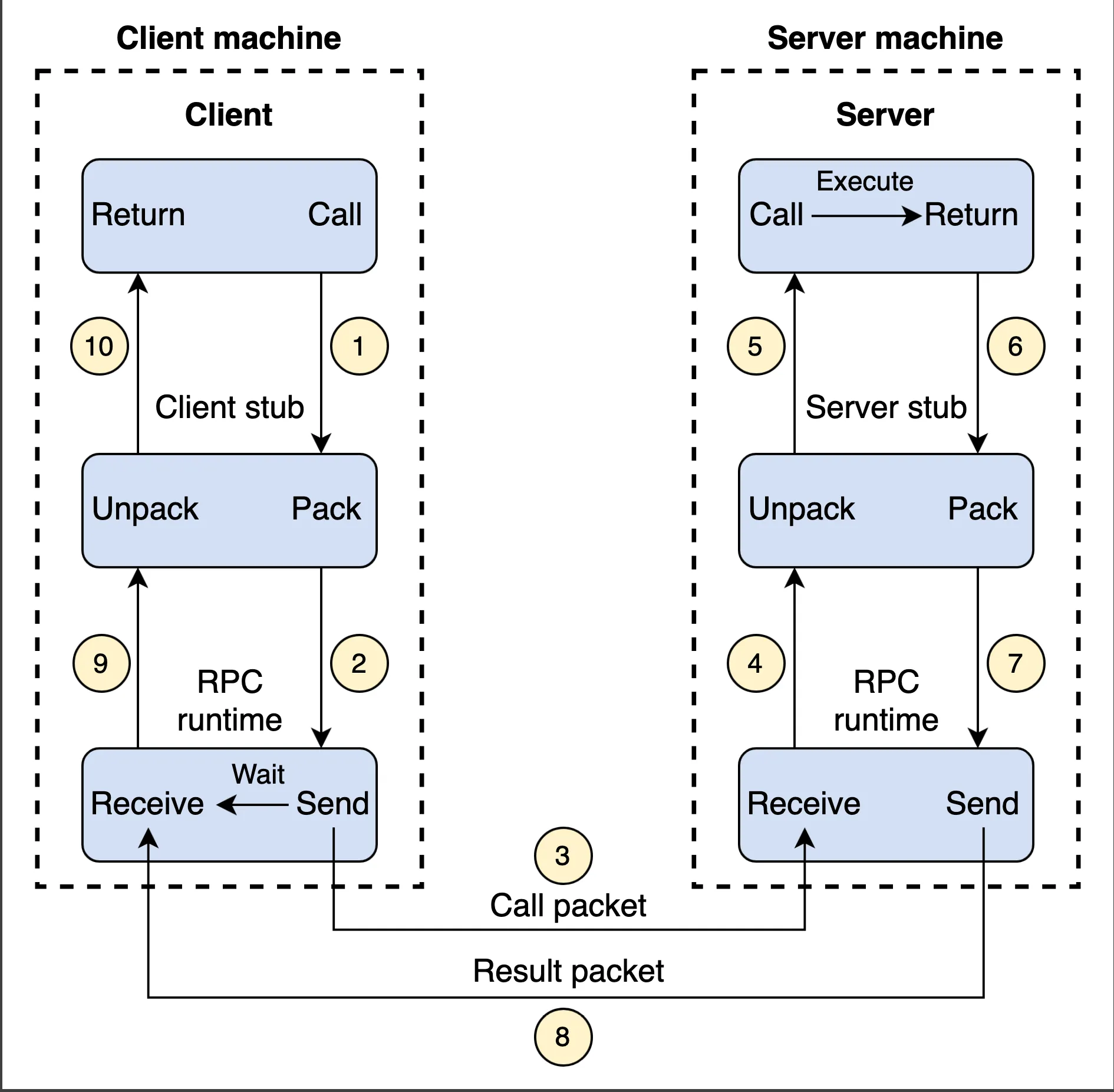
Remote Procedure Call (RPC) is an interprocess communication protocol designed to facilitate interaction within distributed systems. It acts as a mechanism for back-end services to execute code on a remote server as simply as calling a local function. While RPC is favored for its high performance and action-oriented design in internal or complex workflows, it contrasts with RESTful APIs, which are resource-oriented and leverage standard HTTP semantics for scalability and public exposure.
Core Concepts and Benefits
-
Definition: RPC stands for Remote Procedure Call. It is a protocol widely used in distributed systems to enable interprocess communication.
-
Primary Benefit: Back-end services utilize RPC because it provides a simple abstraction, allowing developers to call remote code as if it were a local function. This approach generally offers high performance for internal service communication.
Comparison: RPC vs. RESTful API
| Feature | RPC | RESTful API |
|---|---|---|
| Design Philosophy | Action-oriented (What you want to do) | Resource-oriented (What you’re operating on) |
| HTTP Methods | Typically uses POST for all operations | Uses GET, POST, PUT, DELETE, PATCH with specific meanings |
| Request Example | POST /api with {method: "getUser", params: {id: 123}} | GET /users/123 |
| Function Call Style | Calls remote functions directly | Interacts with resources via HTTP verbs |
| URL Structure | Action-based (/api, /rpc) | Resource-based (/users, /posts, /comments) |
| HTTP Semantics | Ignores HTTP semantics; everything is POST | Leverages HTTP semantics fully |
| Caching | Difficult to cache (POST requests not cached by default) | Easy to cache (GET requests naturally cacheable) |
| Statefulness | Can maintain state between calls | Explicitly stateless (each request is independent) |
| Idempotency | Not necessarily idempotent | GET/PUT/DELETE are idempotent by design |
| Learning Curve | Easier for those familiar with function calls | Requires understanding REST principles |
| Documentation | Requires detailed documentation of methods | Self-documenting through URL structure |
| Data Format | JSON-RPC, XML-RPC, etc. | Typically JSON, but flexible |
| Error Handling | Custom error handling per method | Standard HTTP status codes (200, 404, 500, etc.) |
| Use Case | Action-focused (sendEmail, processPayment) | CRUD operations on resources |
| Scalability | Can be less efficient with stateful interactions | Highly scalable due to stateless nature |
| Browser-Friendly | Not ideal for browser testing | Easy to test in browser address bar |
| API Gateway Compatibility | More challenging to implement gateway patterns | Naturally suited for API gateways and proxies |
| Versioning | Via method names or parameters | Via URL paths or headers |
| Real-time Communication | Can be bidirectional but complex | Typically request-response only |
The distinction between RPC and RESTful APIs lies in their design philosophies, usage of HTTP, and operational behaviors.
-
Design Philosophy:
-
RPC: Action-oriented, focusing on “what you want to do” (e.g.,
processPayment). -
REST: Resource-oriented, focusing on “what you are operating on” (e.g., accessing
/users).
-
-
HTTP Methods and Semantics:
-
RPC: Typically uses the
POSTmethod for all operations and ignores standard HTTP semantics. -
REST: Fully leverages HTTP semantics, using specific verbs like
GET,POST,PUT,DELETE, andPATCHwith standard status codes (200, 404, 500).
-
-
Structure and Documentation:
-
RPC: Uses action-based URL structures (e.g.,
/api,/rpc) and calls remote functions directly. It requires detailed documentation for methods and custom error handling. -
REST: Uses resource-based URLs (e.g.,
/users,/posts) which are often self-documenting. It is browser-friendly and easily tested via the address bar.
-
-
Performance and State:
-
RPC: Can maintain state between calls but is difficult to cache because
POSTrequests are not cached by default. It may be less efficient regarding scalability for stateful interactions. -
REST: Explicitly stateless, making it highly scalable and easy to cache (particularly
GETrequests).
-
Strategic Use Cases
RPC is specifically recommended for scenarios where actions and complex logic take precedence over resource management.
-
Action-Heavy Operations: Ideal for functions that perform specific tasks rather than simple data manipulation. For example, a
processPaymentmethod with parameters for user ID, amount, and currency is clearer in RPC than trying to fit it into a RESTful resource creation model. -
Complex Workflows: Suited for services offering diverse utilities, such as a document conversion service. Operations like
convertPdfToWord,extractTextFromPdf, andmergePdfsare intuitive as function calls but cumbersome to map to RESTful endpoints. -
Internal and Batch Operations: RPC is the preferred choice for internal service-to-service communication and allows for efficient batch operations, such as deleting multiple users in a single request.
Recommendations
-
Public APIs: Use REST when building public APIs or when there are clear resources to expose to external users.
-
Internal Services: Use RPC (or modern alternatives like gRPC) for internal systems and workflows that are heavy on actions and processing.